
AI
Customer Communication Platform: How Businesses Talk to Customers in One Place

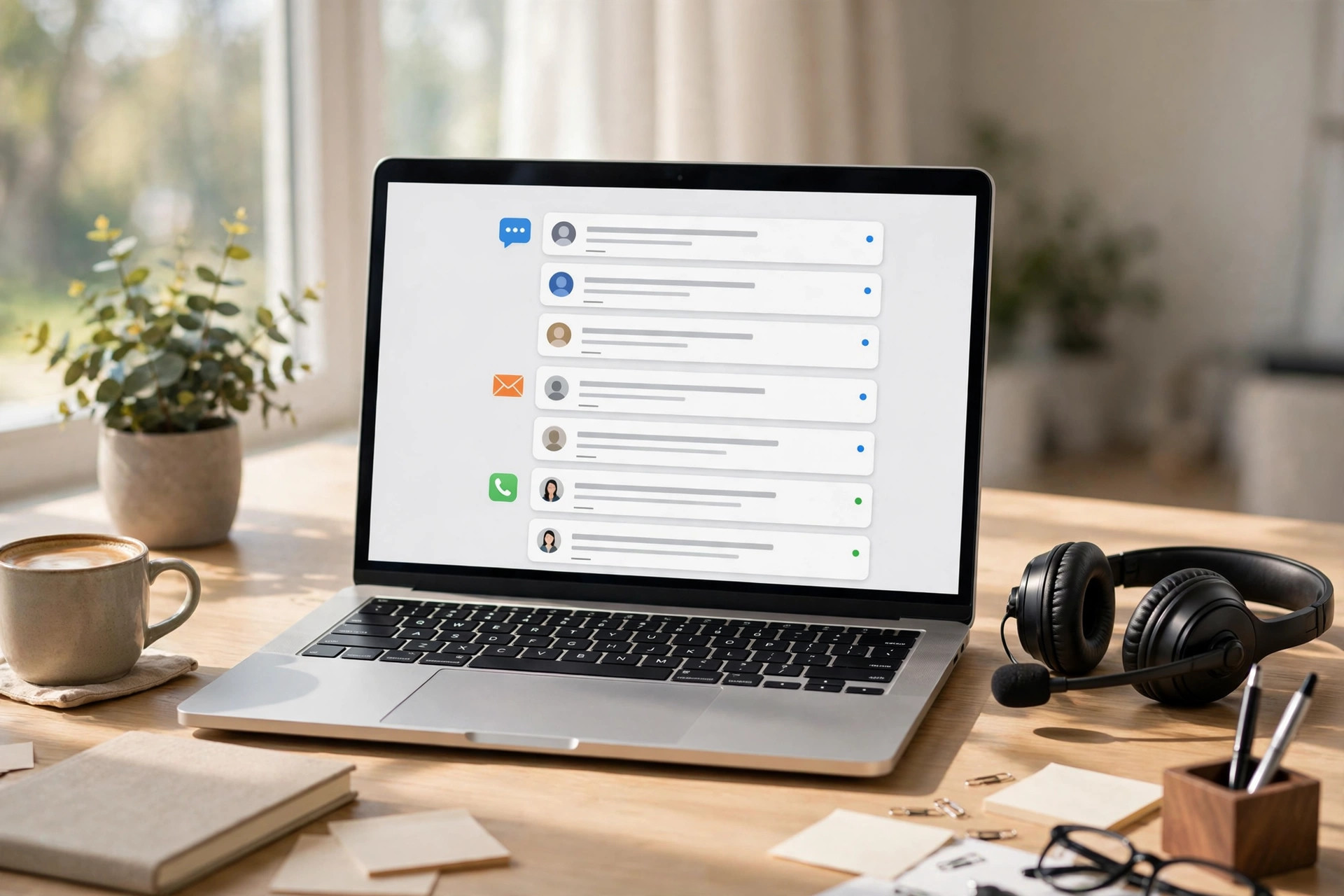
Think about the last time you contacted a business. You might have emailed them, then messaged them on social media when nobody replied, then called. Each time, you probably had to explain yourself from the beginning. That is what happens when a company’s messages live in separate places, handled by separate people, with no shared record. A customer communication platform is the attempt to fix that: one system that gathers email, live chat, phone calls, text messages and social media into a single inbox, so whoever answers can see the whole conversation.
The idea is simple. The execution is where it gets interesting, because the platform has to do three jobs at once: collect the messages, organise them, and help the team answer faster without sounding like a robot.
What it actually does
First, it collects. A customer writes on any channel, and the message lands in the same queue as all the others, with the customer’s history attached — what they bought, what they asked before, whether their problem was resolved. The person answering no longer starts from zero.
Second, it routes. Not every message needs a human straight away. A question about opening hours can be answered automatically. A complaint about a broken delivery probably should not be. Modern platforms use AI to make that first judgement: is this routine, or does it need a person? Getting that judgement right matters, because nothing annoys a customer faster than being trapped in an automated loop when they need a human.
Third, it measures. How long do customers wait? Which questions come up most? Which answers actually solve the problem? That data feeds back into the business — if the same question arrives a hundred times a week, the answer is probably to fix the thing people are asking about, not to answer faster. That is the same lesson as business analytics: the numbers are most useful when they change a decision, not when they fill a report.
Who it suits, and its limits
For a business that talks to customers on more than one channel, a platform like this is close to essential once the volume grows beyond what one person can hold in their head. For a very small business — one person, one inbox, a handful of messages a day — it is usually unnecessary complexity, and a shared email inbox will do.
The limit is the same one that applies to every AI-assisted tool. The platform can draft replies, suggest answers and sort messages, but it cannot care about a customer, and it cannot fix a bad product or a broken process. Customers notice quickly when every reply is polished and nothing changes. The platform is a tool for communication, not a substitute for it — and the businesses that get the most from it are the ones that use the time it saves to actually solve the problems their customers keep reporting.

Every time you tap a screen, speak to a voice assistant, or type a question into an AI chatbot, you are taking part in human-machine interaction — usually shortened to HMI, or the closely related field of human-computer interaction. It is the study of how people and machines work together, and it matters far more than it sounds. A machine can be brilliant inside and useless in practice if the interaction between it and its user is badly designed.
It started with a problem nobody had named
Early computers were operated by specialists, with punched cards and typed commands. That was fine when computers were rare and their users were trained. Then computers spread — to offices, homes, pockets — and the users stopped being specialists. Ordinary people, in a hurry, with no training, had to operate machines of extraordinary complexity. Something had to change, and what changed was the interface: the part of the machine the person actually touches.
The first great shift was the graphical interface — windows, icons, menus, a mouse pointer — which replaced memorised commands with things you could see and point at. The second was the touchscreen, which removed the mouse entirely and let people touch the thing itself. The third, happening now, is conversation: voice assistants and AI chatbots that let people use ordinary language instead of learning the machine’s language at all.
Each shift lowered the barrier, and each one raised a new question. When anyone can talk to a machine, what should the machine be allowed to do on their behalf? When an AI answers a question, how does the person know whether to trust the answer? Those are not engineering questions. They are interaction questions, and they are the field’s hardest problems today.
What makes an interaction good
Researchers have spent decades measuring this, and the findings are consistent enough to summarise. A good interaction is, first, predictable: the same action produces the same result, so people can build a mental model of how the thing works. Second, it gives feedback: when you tap a button, something visibly happens, so you know the machine heard you. Third, it is forgiving: mistakes are easy to undo, so people are willing to explore instead of tiptoeing. Fourth, it respects attention: it asks for as little of your time and memory as possible, because both are limited.
A bad interaction fails in the opposite ways, and you have met all of them. The button that gives no sign it was pressed, so you press it three times. The error message that says “error 0x80004005” and nothing else. The form that erases everything you typed because of one wrong field. The voice assistant that confidently misunderstands you and then will not let you correct it. None of these are failures of computing power. They are failures of interaction design.
Where AI changes the field
AI makes the interaction more powerful and more fragile at the same time. A chatbot can understand a vague, badly worded request that no menu system could handle. It can also misunderstand it confidently, invent an answer, and present it as fact — and the user, who cannot see how the answer was produced, has no easy way to check. That is why the newest work in the field is about transparency: showing people what the machine is confident about, what it is guessing, and how to correct it.
It also changes who designs the interaction. When the machine’s behaviour is learned from data rather than written as rules, the designer cannot simply list what the machine will do in each situation — because nobody knows, exactly, until it is tested with real people. Testing with real people, watching where they hesitate or get confused, has become more important, not less.
This is the same principle behind good app design — the interface is the product, as far as the user is concerned, as our guide to how a mobile app goes from idea to your phone shows — and it is why the AI tools people use every day, from writing assistants to image generators, succeed or fail largely on how they feel to use, not on how clever the model underneath is. The machine is the easy part now. The conversation between person and machine is the hard part, and it is getting harder as machines get more capable. That is what human-machine interaction studies, and why it will matter more, not less, as AI spreads into every device we own.
-

 CRYPTO9 months ago
Crypto.com Credit Card: Complete Guide to Rewards, Benefits, and How It Works
-

 BUSINESS7 months ago
Outsourcing Customer Service: A Complete Guide to Benefits, Challenges, and Smart Strategies
-

 HEALTH9 months ago
Benefits of Drinking Lemon with Warm Water Daily
-

 BLOG7 months ago
Soundgasm: A Complete Guide to the Popular Audio Sharing Platform
-

 BUSINESS8 months ago
How to Effectively Use Betanden for Enhanced Productivity
-

 TECHNOLOGY10 months ago
Fappelo: A Complete Guide to Digital Innovation and Brand Growth
-

 BUSINESS8 months ago
Deshoptec com: A Complete Guide to Understanding Deshoptec com in the Modern E-Commerce World
-

 HEALTH9 months ago
Foods High in Omega 3 Fatty Acids: Complete Guide to Nutrient-Rich Sources